
What is the Gradebook?
The CareerSafe Gradebook is a complimentary tool that allows instructors and administrators to track grades, view course progress, print completion certificates, and more. Instructors will have a gradebook for each of their groups. Every gradebook is then divided into sections, called Gradebook Tables, for each course students in that group are enrolled in.
To access the Gradebook, click Gradebook on the navigation bar in your CareerSafe Campus.
The Gradebook Tables
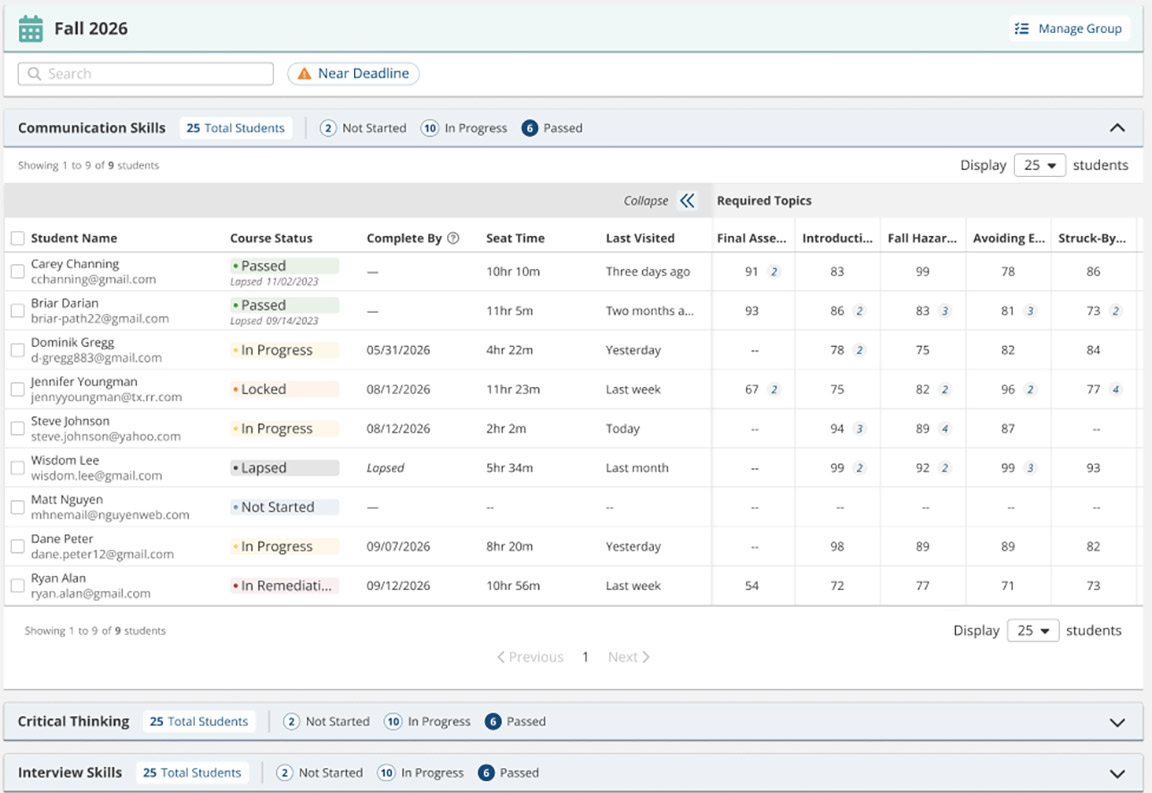
Each Gradebook Table is divided into columns that give you different pieces of important information about a student’s progress in the course. Let’s take a look at what each of those columns is for. We’ll be reviewing them in the order in which they appear in the table, from left to right.
Student Name
Your most recently accessed gradebooks will appear in the Recent Activity Card at the top right.
Course Status
The Course Status column in the Gradebook table displays the Enrollment Status Chip. This colored rectangle tells you what a student’s course progress status is. The statuses displayed are: Passed, Completed, In Progress, Lapsed, Not Started, and In Remediation.
- Courses in Passed, Completed, and Lapsed status will display the date on which the status was met below the status chip.
- Courses in In Progress status will have a progress bar beneath the status chip for a visual representation of the student’s progress through the course. Hovering over the progress bar will show you the actual percentage complete.
Complete By Date
The Complete By column shows the date by which the student needs to finish the course (180 days after they begin) to meet time-to-complete requirements.
If the date is within two weeks of the current date, you’ll see the Near Deadline icon () beside the date.
Seat Time
The Seat Time column can be seen by clicking Expand (above the Complete By column), and it displays the amount of time the student has spent in the course.
Last Visited
The Last Visited column can be seen by clicking Expand (above the Complete By column), and it shows the last time the student visited a course, in a “Today”, “Yesterday”, “Last Week” type display. Hovering will display the exact date/time the student last visited the course.
Course Completion
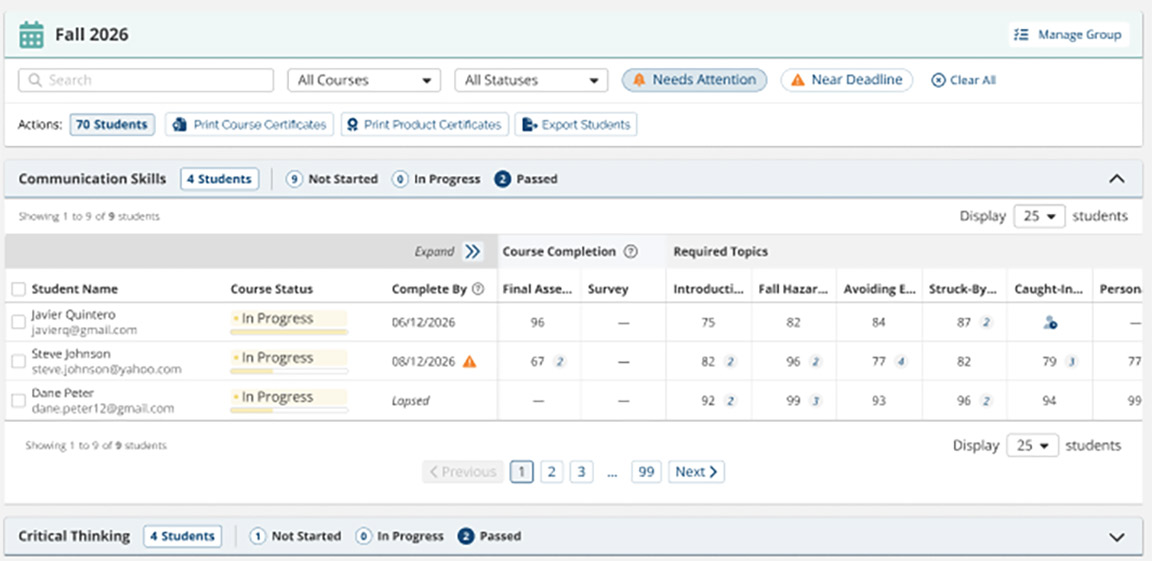
The Course Completion section displays just before the Topic columns and contains the Final Assessment column (for courses that have one) and the Survey column. Both the Final Assessment (if there is one) and the Course Survey must be complete for a course to be considered complete.
- The Final Assessment column displays a student’s Final Assessment grade, along with the number of attempts it took them to achieve that grade.
- The Survey column shows whether the student has completed the end of course survey, indicated by blue circle with a check mark inside it.
Topics
The Gradebook table contains a column for each topic in a course, with headers indicating Required Topics and Supplemental Topics. Within each of these Topic columns, instructors can see the associated grade for that topic, as well as the number of attempts it took the student to achieve that grade.
- Clicking the number of attempts will open the Topic Detail Drawer, which displays detailed information about a student’s activity within the topic including:
- Time on Topic — total time the student spent on the topic
- Topic Assessment — detailed breakdown of each Topic Assessment attempt, including grade, number of correct answers, and date and time of attempt.
- Topics that are currently in progress will have an In Progress icon (blue person with a clock) in the column instead of a grade and attempt number.
Search + Filter Bar
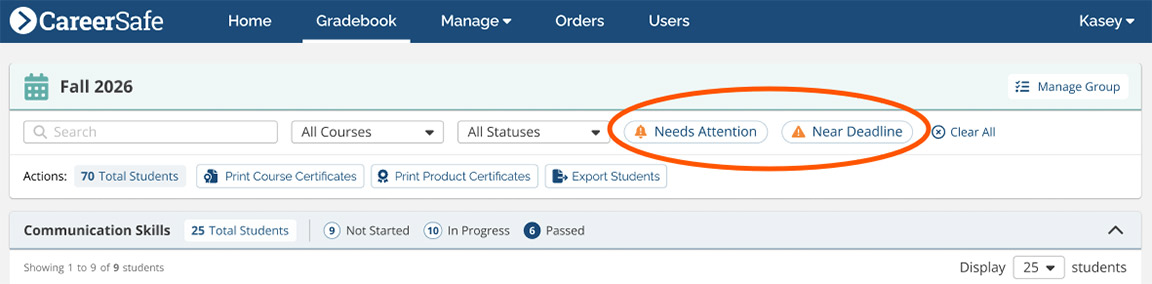
We’ve made it a little easier to find exactly the information you need with our Search + Filter Bar. Here, you can select one or multiple courses and statuses to filter by. The numbers displayed in the Course Header Bar will change to reflect the number of students in a course that match your current search and filter settings.
Our two Quick Filters — the Near Deadline Quick Filter and Needs Attention Quick Filter — all you to quickly filter for two specific criteria that require awareness or action.
Near Deadline Quick Filter
This filter allows you to filter search results by students who have two weeks or less to complete their course.
Needs Attention Quick Filter
This filter lets you filter search results by those students in a status that requires action from the instructor. These statuses include In Remediation, Lapsed (with Remaining Resets), and Locked.
Bulk Actions
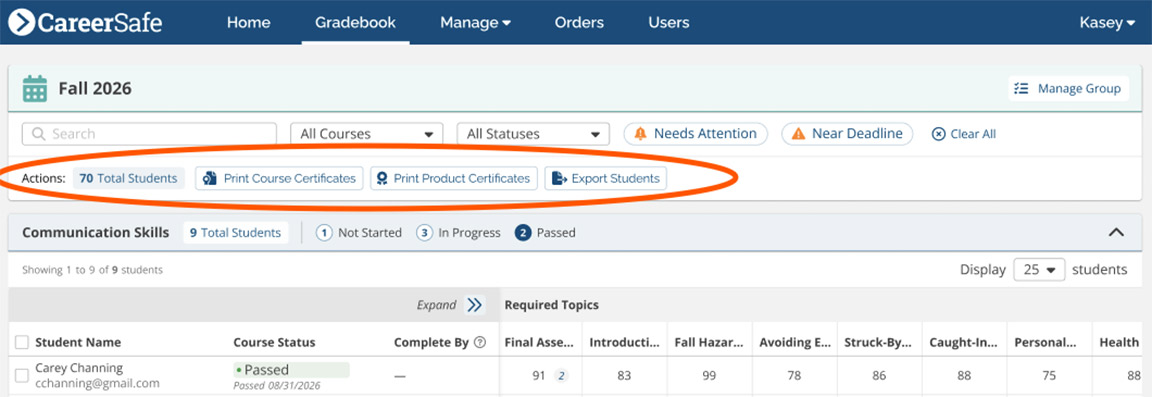
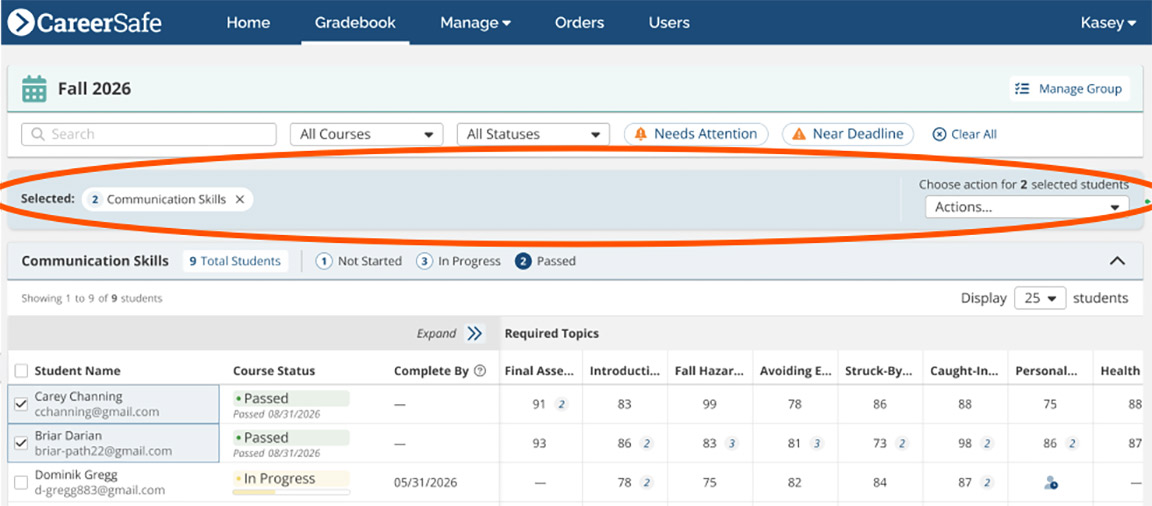
Bulk actions are found in either the Global Bulk Actions Bar or Floating Bulk Actions Bar, depending on whether selections have been made. Both bars will display below the Search + Filter Bar.
The bulk actions are:
- Print Course Certificates — download and/or print PDFs of student Course Completion Certificates
- Print Product Certificates — download and/or print PDFs of student Product Completion Certificates
- Export Students — download and/or print an Excel version of your gradebook
- Order Reprint — order OSHA card reprints for students
Global Bulk Actions Bar
This bar is visible on the gradebook page by default and when no selections have been made. When no filters are applied, bulk actions apply to all students in the gradebook. On this bar, you can see a total number of students (not enrollments), plus available bulk actions.
Floating Bulk Actions Bar
The Floating Bulk Actions Bar is visible once a selection has been made and will replace the Global Bulk Actions Bar. On this bar, you will see a total number of students (not enrollments) selected, as well as a course chip for each course selected students are enrolled in. At the far right of the bar, you’ll see the Actions Pop-Over Menu, where you can choose which action you’d like to take for the selected students. If no selected students are eligible for an action, it will be disabled (greyed out).
Student Drawer
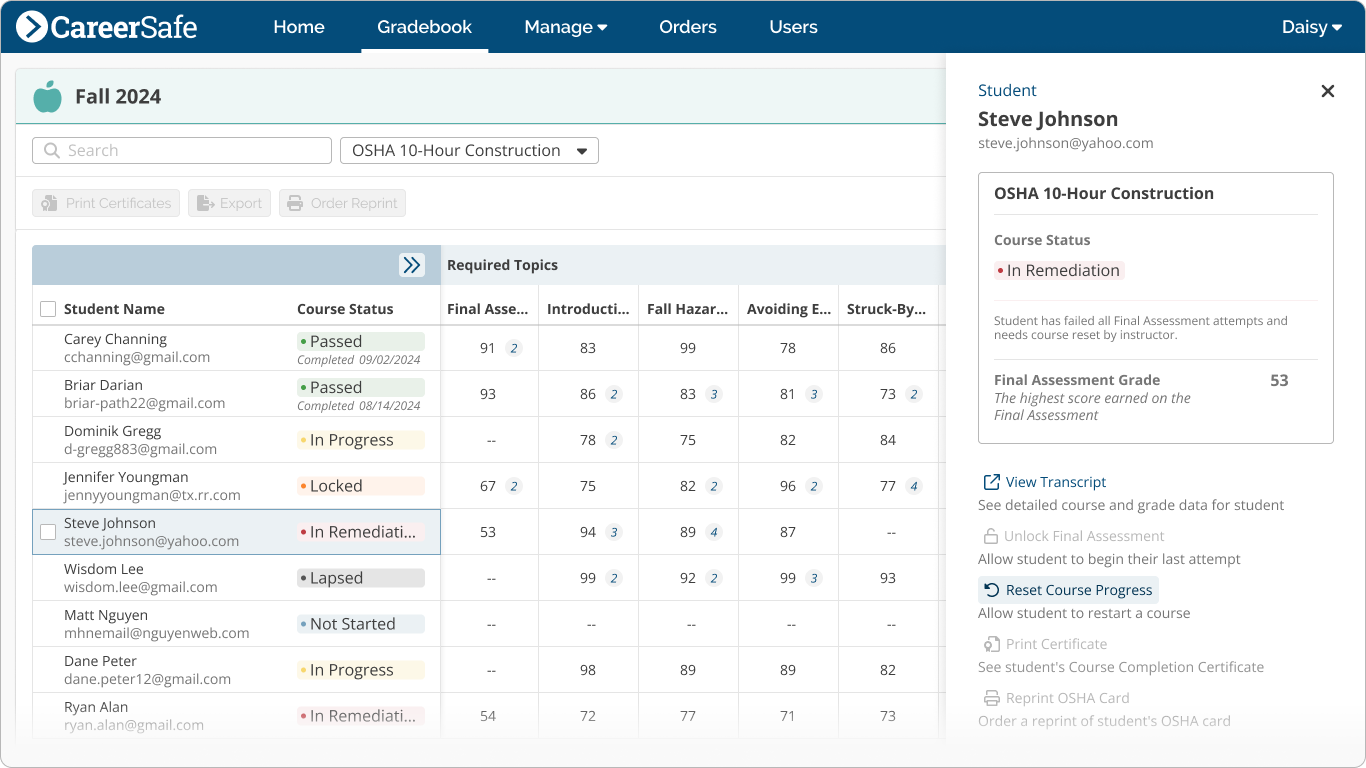
The Student Drawer is accessed by clicking a member’s name within the gradebook. This feature provides instructors quick access to:
- Information about a specific member’s course status, percent complete, and average grade
- Actions that can be taken related to that member’s course progress:
- View Transcript
- Unlock Final Assessment
- Reset Course Progress
- Print Certificate
- Reprint OSHA Card
Note: Actions are disabled (greyed out) if they can’t be completed because of the student’s status.
What is Assessment Locking?
As required by OSHA, students are only allowed three attempts at passing the Final Assessment for OSHA 10-Hour courses with a 70% or higher. If they fail all three attempts, they will have to restart the course from the beginning. The Assessment Locking feature allows instructors to prevent students from using their last Final Assessment attempt without approval.
Once you have enabled Assessment Locking, students who try to begin their third OSHA 10-Hour Final Assessment attempt will receive a notification informing them that the assessment is locked and they must contact their instructor before attempting the assessment again.
Note: The Assessment Locking feature does not function with third-party courses (e.g., OSHA 30-Hour Construction, HAZWOPER, and First Aid).
Manage Assessment Locking
Assessment Locking is managed in the Settings page for each group.
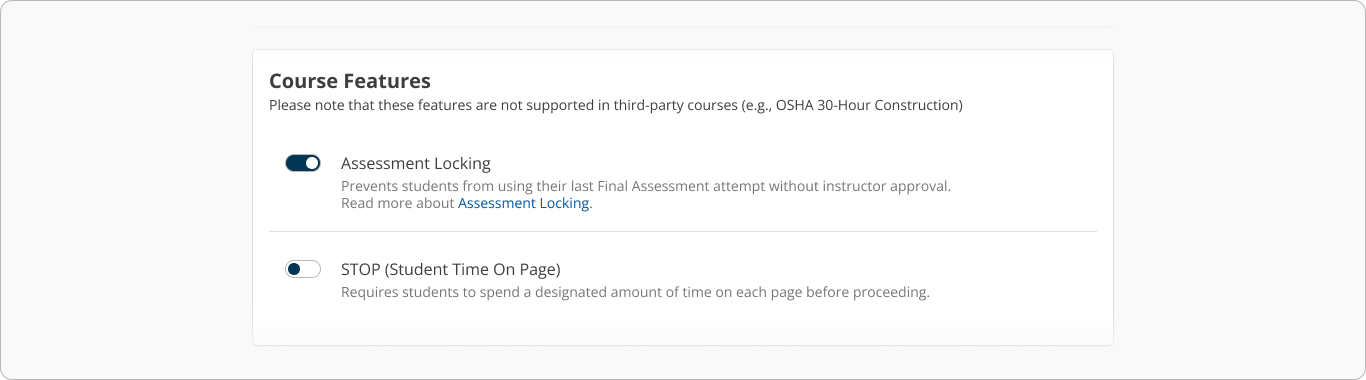
Note: Instructors can unlock an assessment from the Student Drawer in the Gradebook or from the Locked Assessments Card on their Home page.
What is Student Time on Page (STOP)?
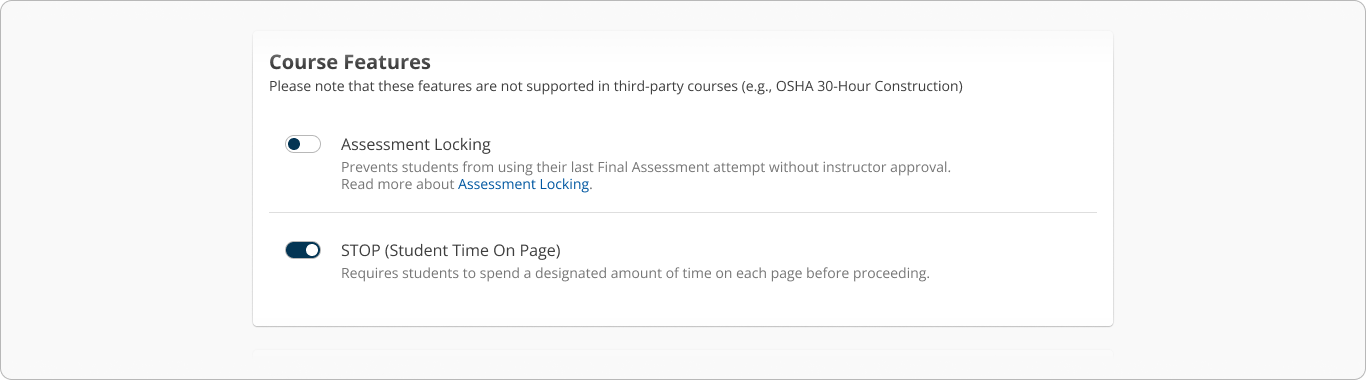
When enabled by an instructor, the STOP feature requires students to proceed linearly through our courses. This prevents students from moving forward until they have completed each page by either interacting with the activity or waiting for the audio to play in its entirety.
Managing STOP
STOP is managed in Group Settings.
Course Resets
What are Course Resets?
Although rare, some students use all three of their allowed attempts at the OSHA course Final Assessment without obtaining a passing score (70% or higher). Upon their final failed attempt, the student will receive an informing them that an instructor or administrator may allow them to restart their OSHA course from the beginning.
Note: Resetting a student’s course will clear that student's progress and require them to retake the entire course from the beginning. Their 180-day timeframe for course completion will also be reset.
How do I reset a student's course?
Instructors can manage Course Resets from the Student Drawer in the Gradebook or from Course Resets Card on their Home page.
Presentations, Lesson Plans, and Study Guides
Each CareerSafe course is accompanied by complementary presentations and lesson plans, providing instructors with pre-made, but customizable materials to use as they guide students through course content. These can be accessed via the Course Resources Card on their Home page.
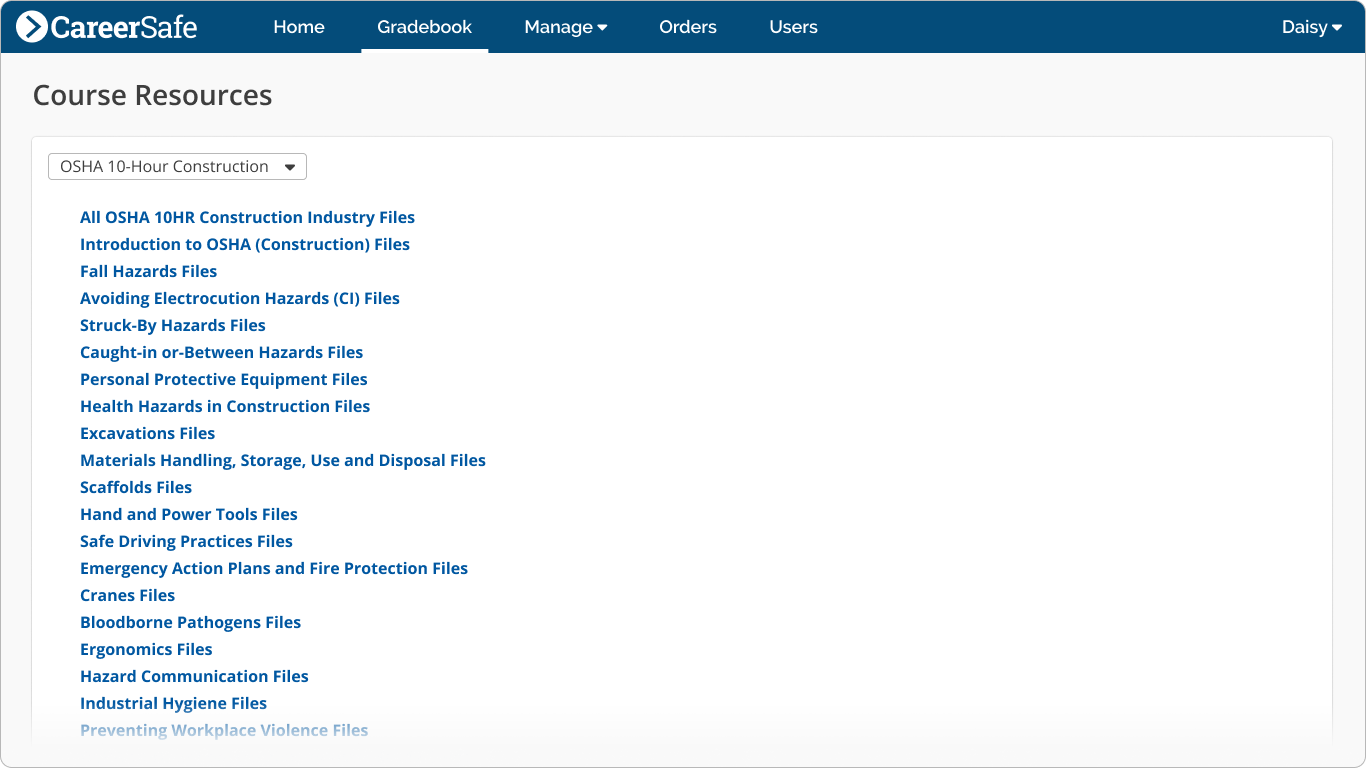
What are the presentations in the Course Resources?
Our presentation bundles provide detailed information reflecting content in each course topic, as well as avenues for content reinforcement, assignment creation, and student accommodations. PowerPoints are editable, customizable, and designed to be dyslexia-friendly and fully accessible so they can also be used as student handouts.
What do the CareerSafe Lesson Plans include?
Lesson Plans are designed to be Lesson Plans are designed to be customizable, one-stop documents for capturing instructional strategies for each of our courses. Each lesson plan contains:
- lesson summaries, including topic descriptions, topic time estimates, and topic learning objectives
- suggestions for common accommodations using existing CareerSafe tools
- lesson procedures, including module time estimates, module objectives, and number of knowledge checks per module
- quick reference for Topic and Final Assessments
- customizable space for announcements or homework reminders
What are the CareerSafe Study Guides?
CareerSafe’s study guides are accessible by both students and instructors and are available both as an interactive online feature found in the course and as a downloadable resource. Students can use study guides to review for their Final Assessment or check understanding of key course content. They can also be used by instructors as a resource for practice questions or essential topic information to be used for in-class instruction.